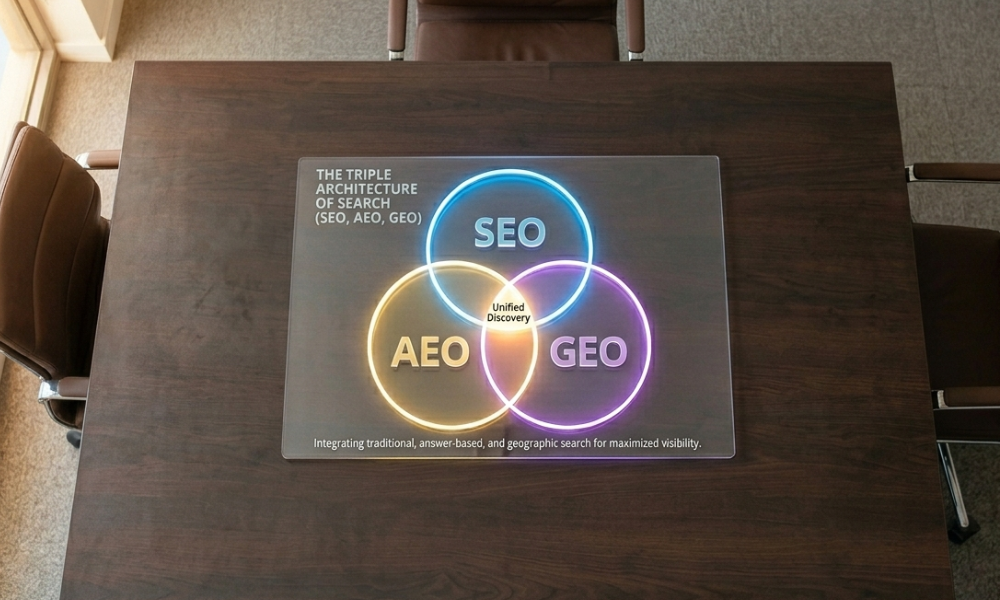
Think about the last time you needed information. Did you open a browser, type a few keywords into Google, and scroll through ten blue links? Or did you ask ChatGPT, or Gemini, or simply tapped a question into TikTok’s search bar? The honest answer, for most of us, is that it depends, and that dependency on multiple discovery channels is precisely what has changed everything. Search hasn’t disappeared. It has evolved into something far broader, far smarter, and far less predictable than the world marketers built their strategies around for the past two decades.
For businesses that want to remain visible in this new landscape, understanding the distinction between SEO, AEO, and GEO isn’t just helpful, it’s becoming essential.
SEO: Still the Foundation, But No Longer the Full Picture
Search Engine Optimisation remains the bedrock of digital visibility. At its core, SEO is about ensuring your website appears prominently when people search on Google or Bing – through strong content, technical site health, and authoritative backlinks. It works, it matters, and any business ignoring it is leaving serious opportunity on the table.
However, SEO alone no longer captures the full spectrum of how people discover information online. It is a necessary foundation, but you cannot take shelter in a foundation alone.
AEO: When the Question Becomes the Query
In comes Answer Engine Optimisation – it represents the shift from keyword-based searching to conversational, question-led discovery. And to understand why this shift happened, you have to look at behaviour. Search changed when people stopped typing keywords and started asking questions naturally, expecting a direct response rather than a list of links to investigate.
So instead of typing “best accountant Centurion,” someone now asks “who is the best accountant for small businesses in Centurion?” or “do I need to register for VAT if I’m a freelancer?”. These are real questions, asked naturally, and the platforms people use – Google, MetaAI, ChatGPT – have adapted to answer them directly. The goal of AEO, therefore, is no longer simply to rank on page one, it is to become the answer. In a world where many users never scroll past the first response they receive, being the answer is infinitely more valuable than merely appearing near it.
Click Here for an in-depth guide on AEO

GEO: Optimising for the AI-Generated Response
Generative Engine Optimisation is where search stops showing results and starts generating conclusions. When someone asks ChatGPT a question about your industry, it doesn’t return a list of links, instead it synthesises an answer, drawing from sources it has determined to be credible, consistent, and authoritative.
The critical question for any business, then, is: how does an AI decide whose voice to include in that answer? It comes down to a few key factors. AI systems are trained to recognise entities – brands, people, organisations – that appear consistently and credibly across multiple reputable sources. If your brand is regularly mentioned on respected industry sites, if your content is clear and factually reliable, if your messaging is coherent across your website, your press coverage, and your social presence, you begin to build what might be called AI trust. You become a source the system has learnt to reference. Conversely, brands with thin content, inconsistent messaging, or no real presence beyond their own website are largely invisible to these systems, regardless of how well they rank on Google.
GEO, therefore, demands a shift in thinking, from “how do I rank?” to “how do I become referenced?” It means building genuine authority, earning mentions on reputable external sites, and ensuring your brand narrative is coherent wherever AI systems might encounter it.
What This Means for Businesses
Modern visibility is no longer about ranking in one place, it’s about being discoverable everywhere decisions are made. Whether you run an e-commerce business in London, a law firm in Pretoria, a retail brand in Durban, the same principle applies – a well-crafted piece of content needs to rank on Google, answer a specific question directly, and demonstrate the kind of authority that earns inclusion in an AI-generated response. That requires a more deliberate approach, one built around clarity, credibility, and genuine expertise rather than keyword density or technical shortcuts. Think less about chasing algorithms and more about becoming the most trusted, clearest voice in your space.
The Future Is Already Here – And It’s Moving Fast
The phrase “the future of search” implies something distant and theoretical. In truth, it has already arrived. Millions of people are bypassing traditional search entirely in favour of AI-generated answers, and that number grows every month. However, what comes next is more remarkable still, search is evolving towards something predictive and deeply personalised, where AI anticipates your questions before you fully form them and surfaces answers before you even begin to type.
The brands that adapt now, building authority and trust across every channel where discovery happens, won’t just survive that shift – they’ll be the ones the AI already knows to recommend.